
Who designed the Burj Khalifa?
Updated October 27, 2026
Quick answer
The Burj Khalifa was designed by the Chicago firm Skidmore, Owings & Merrill (SOM). Adrian Smith was the chief architect and Bill Baker the chief structural engineer. SOM finished the design in 2006 and the tower opened in 2010.
Adrian Smith led SOM's design of the Burj Khalifa. His concept drew on the geometry of a regional desert flower and on the patterns of Islamic architecture, as SOM describes it. Bill Baker devised the structural system that makes the height possible: a hexagonal core braced by three wings, the buttressed core. The developer was Emaar Properties, and the builders were Samsung C&T with BESIX and Arabtec, with Turner as project manager. SOM's interiors team also designed the lobbies and other interior spaces. You can see the design up close from the decks on the Levels 124 & 125 ticket, from $51 (AED 189, at 1 USD = 3.6725 AED).
Adrian Smith at SOM
Adrian Smith, born in Chicago in 1944, joined Skidmore, Owings & Merrill in 1967. He was a design partner from 1980 to 2003 and a consulting design partner from 2003 to 2006, according to Wikipedia. At SOM he also designed Jin Mao Tower in Shanghai, completed in 1998, and Trump International Hotel and Tower in Chicago, completed in 2009. SOM lists 2006 as the year the Burj Khalifa design was finished. That same year Smith left to found Adrian Smith + Gordon Gill Architecture in Chicago, the firm that designed Jeddah Tower in Saudi Arabia, which is planned to be taller than the Burj Khalifa. See our comparison with Jeddah Tower.
The Y-shaped plan and desert flower
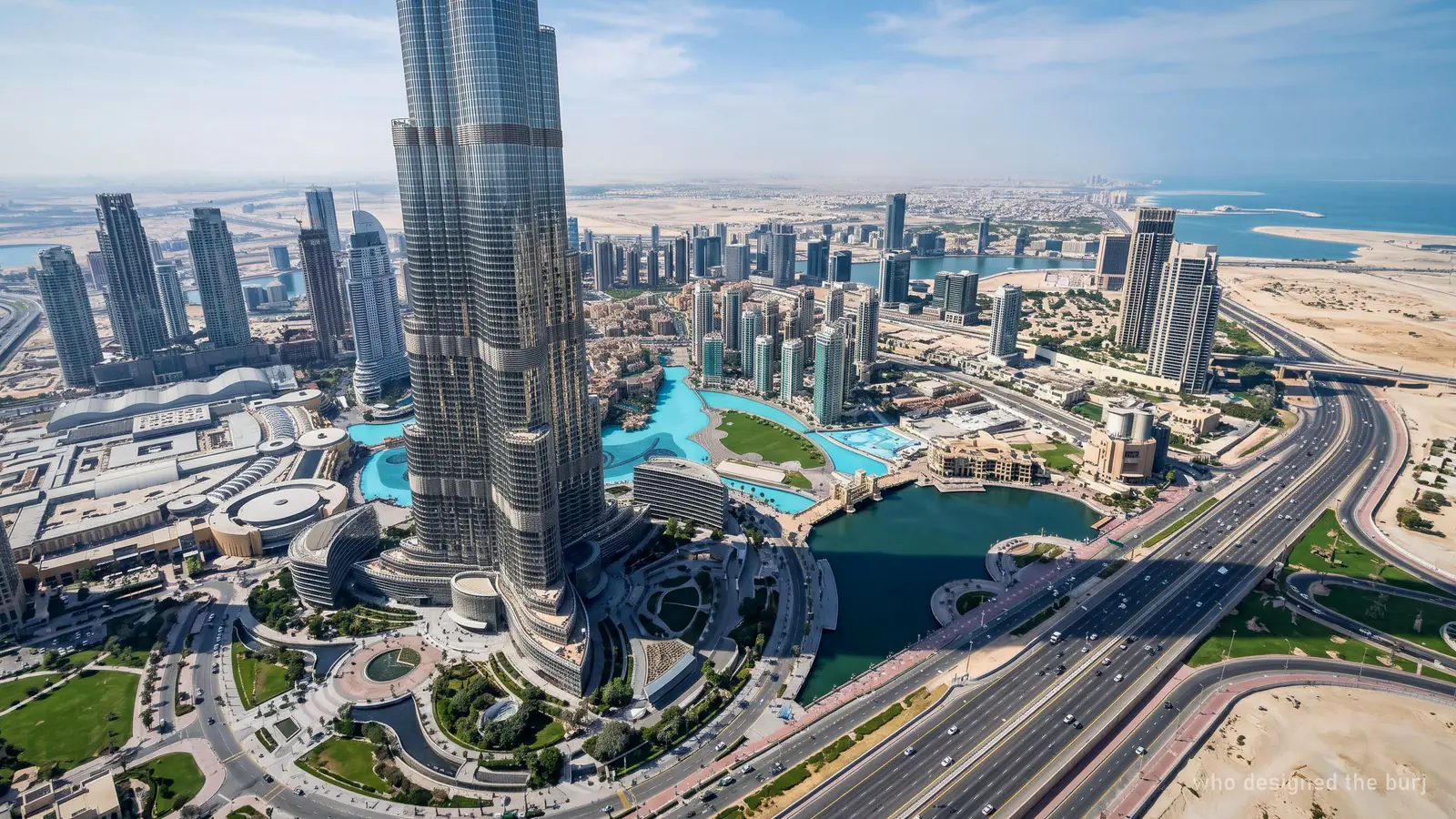
From above, the tower is shaped like a Y with three wings. SOM says the Y-shaped floor plan maximises views of the Arabian Gulf and that the design is inspired by the geometries of a regional desert flower and the patterning systems of Islamic architecture. Wikipedia names the flower as the Hymenocallis, a spider lily, and also links the style to Islamic forms such as the spiral minaret of the Great Mosque of Samarra. As the tower rises, its wings step back 27 times in a spiral, so it narrows toward the spire. SOM says the stepped shape helps to "confuse the wind", which reduces sway.
- Plan — Y-shaped, three wings around a central core
- Inspiration — A desert flower (Hymenocallis) and Islamic architecture
- Setbacks — 27, in an upward spiral
Structural engineering (Bill Baker)
William F. Baker, a structural engineering partner in SOM's Chicago office, was the tower's chief structural engineer. Wikipedia describes the system he developed: a hexagonal core reinforced by three buttresses that form the Y. The core and wings brace each other against wind and twisting forces, avoid the need to transfer columns between floors, and carry loads in a smooth path from the spire to the foundations. The structure is reinforced concrete up to the spire, which is steel. At its peak the tower sways about 1.5 m, according to Wikipedia. Baker received the Institution of Structural Engineers' Gold Medal in 2010. Read how Burj Khalifa was built for the construction story.
The wider team and the interiors
A tower this size needed many firms beyond the architects. Wikipedia lists Hyder Consulting as supervising engineer, NORR for architectural supervision and GHD for independent testing. Samsung C&T, BESIX and Arabtec were the main contractors, Turner was project manager, and Far East Aluminium supplied the cladding of glass, aluminium and stainless steel. Inside, SOM's interiors team designed the lobbies, amenities and offices, and SOM says the building holds more than 500 works of art. The best known is Jaume Plensa's "World Voices" installation, with 196 cymbals. Around the base, an 11-hectare park by SWA Group repeats the desert-flower theme. Our Burj Khalifa facts page collects more numbers.
Frequently asked questions
Who was the architect of the Burj Khalifa?
Adrian Smith, as design partner at Skidmore, Owings & Merrill (SOM) in Chicago.
Who was the structural engineer of the Burj Khalifa?
William F. (Bill) Baker of SOM, who developed its buttressed-core structure.
What inspired the design of the Burj Khalifa?
SOM cites a regional desert flower, which Wikipedia names as the Hymenocallis, and the patterns of Islamic architecture.
Who built the Burj Khalifa?
Samsung C&T with BESIX and Arabtec as main contractors, for the developer Emaar Properties, with Turner as project manager.
What style of architecture is the Burj Khalifa?
Wikipedia calls it neo-futurist, drawing on Islamic architecture such as the spiral minaret of Samarra.
Sources